You click "Submit Application." A confirmation email arrives. Then... silence. What's happening on the other side?
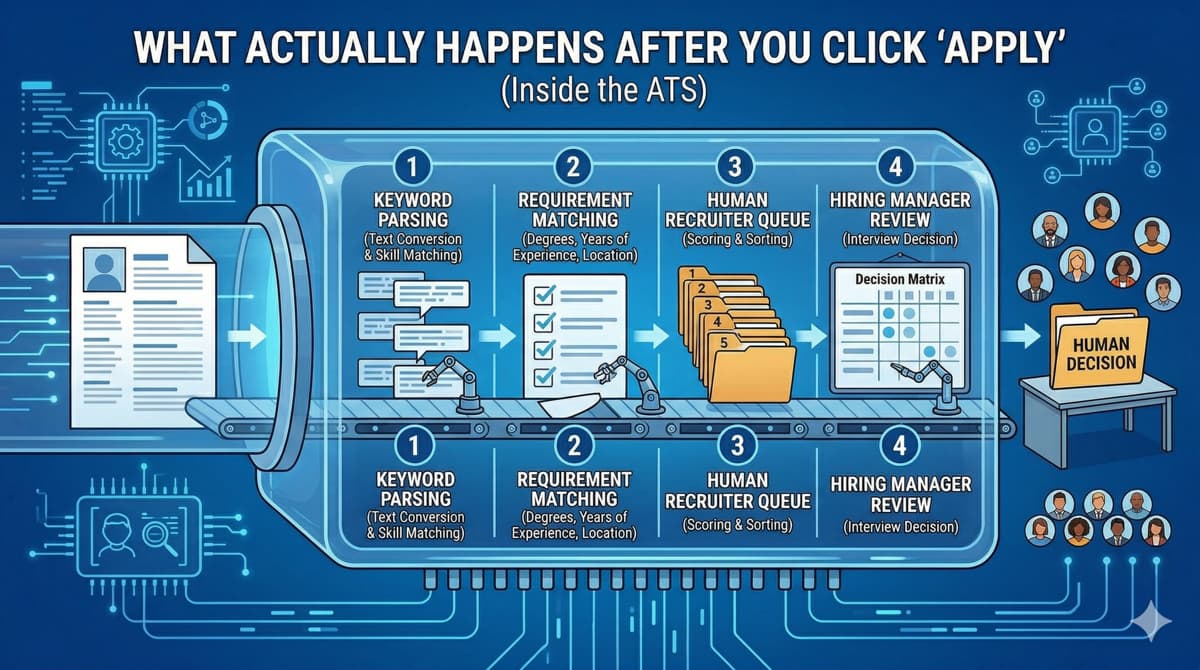
Stage 1: Parsing (0-2 seconds)
The ATS (Applicant Tracking System) ingests your resume and attempts to extract structured data: name, email, work history, education, skills. This is where formatting matters enormously.
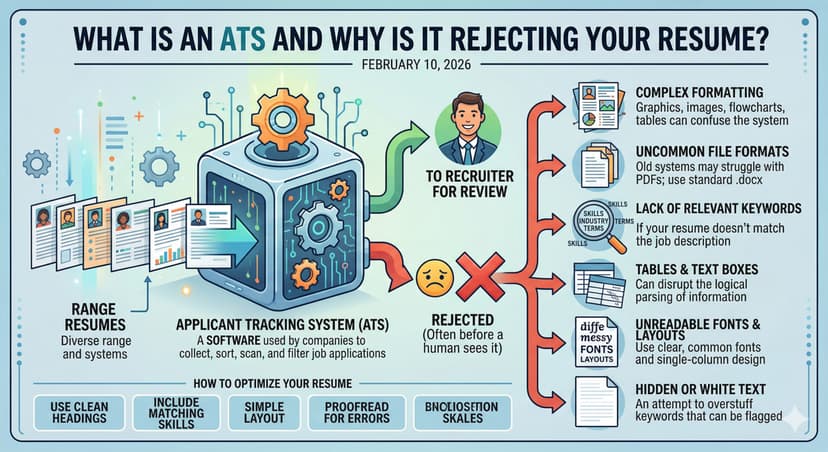
Common parsing failures: - Tables and columns — Most ATS systems read left-to-right, top-to-bottom. Two-column layouts scramble your experience order - Headers and footers — Some systems skip content in headers entirely. If your name is in a header, the ATS might not know who you are - Images and icons — Completely invisible to the parser. Those skill-level bar charts? The ATS sees nothing - Non-standard section headings — "Where I've Made an Impact" instead of "Experience" confuses the parser
This is why every system parses your resume differently. Greenhouse handles tables better than Taleo. Workday struggles with certain date formats that Lever handles fine. There's no single "ATS-friendly" format — which is why testing against multiple systems matters.
Stage 2: Scoring (2-5 seconds)
Once parsed, the ATS compares your extracted data against the job requirements. This is the keyword matching phase.
The algorithm is looking for: - Hard skills match — Do you have the specific technologies, certifications, or tools listed? - Experience level — Does your tenure align with the "5+ years" requirement? - Title alignment — Is your current/recent title similar to the target role? - Education — Degree requirements, if specified
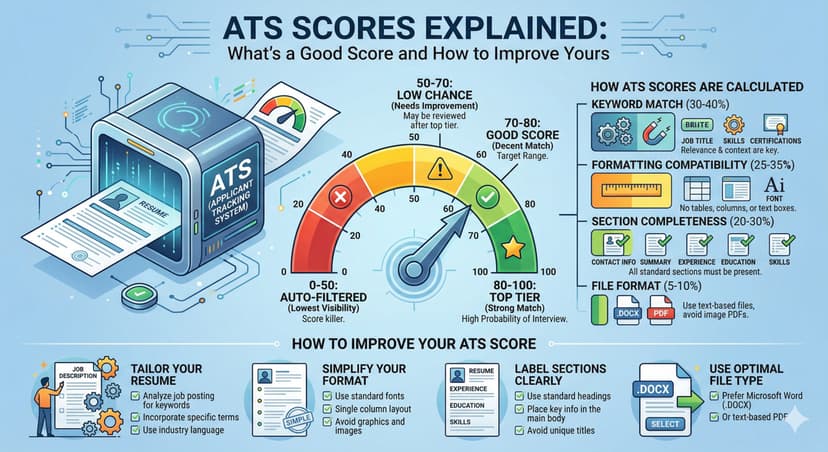
Many systems use scoring or ranking models after parsing. Higher-scoring resumes are more likely to appear near the top of a recruiter's review queue, while low-scoring resumes often need stronger keyword alignment, clearer experience evidence, or cleaner formatting.
Stage 3: Ranking
Your resume is now ranked against every other application for that role. The recruiter sees a sorted list — highest scores first.
Here's the critical insight: recruiters don't review all applications. A typical corporate recruiter spends 6-8 seconds per resume and reviews the top 20-30 candidates for each role. If 200 people apply, 170 of them are never seen by a human.
Your ATS score determines your position in that stack. The difference between a 72 and an 84 could be the difference between page 1 (reviewed) and page 3 (ignored).
Stage 4: Human Review (6-8 seconds per resume)
If your resume makes it to a human, you have about 7 seconds to make an impression. Eye-tracking research shows recruiters scan in an F-pattern:
- First line of your summary (1.5 seconds)
- Most recent job title and company (2 seconds)
- First bullet point under each role (1.5 seconds each)
- Education section (1 second)
This is why your summary and first bullets under each role carry disproportionate weight. A buried achievement at bullet point 6 might never get read.
Where Most Applications Die
- 44% fail at Stage 1 (parsing errors — fixable formatting issues)
- 31% fail at Stage 2 (keyword mismatch — fixable with targeted enhancement)
- 15% fail at Stage 3 (ranked too low — fixable by improving score)
- 10% fail at Stage 4 (human review — harder to optimize, but heatmaps help)
The good news: many screening failures happen at stages you can directly improve. Fix your formatting (Stage 1), match your keywords to the job description (Stage 2), and strengthen your relevance signals (Stage 3).
That's 3 out of 4 failure points eliminated before a human ever gets involved.