"Nobody reads cover letters anymore." You've heard it. Maybe you've said it. But the data tells a more nuanced story.
What the Research Says
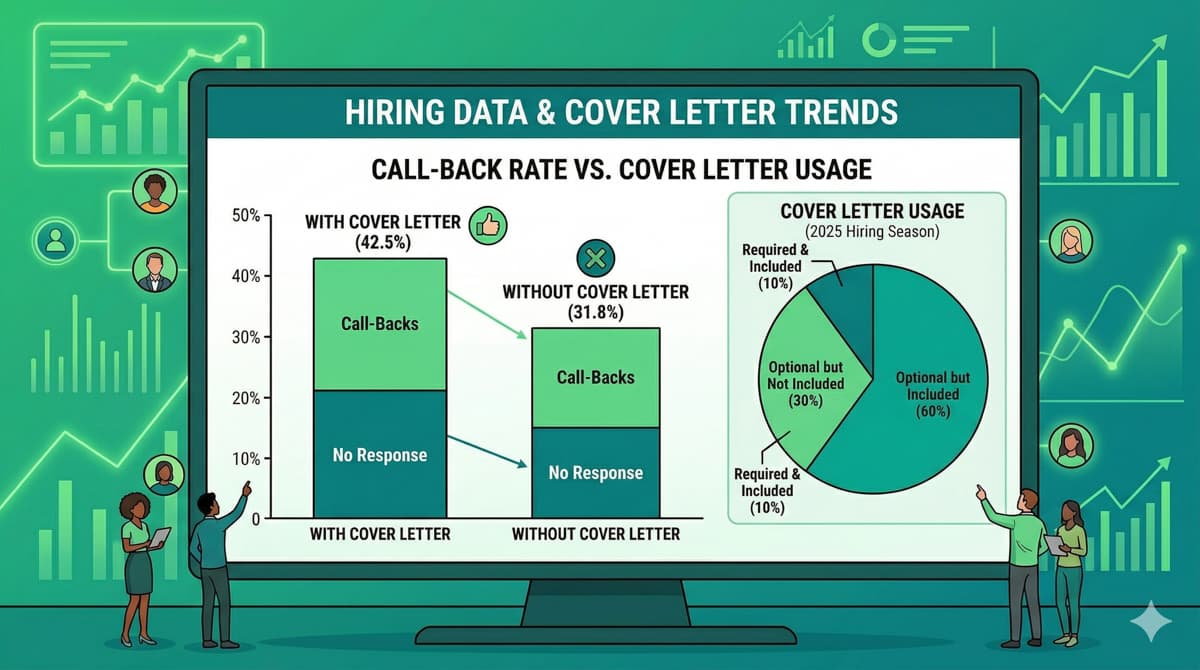
A 2024 ResumeGo study sent 7,287 applications to real job postings — half with cover letters, half without. Applications with tailored cover letters received 53% more callbacks than those without one.
But here's the catch: generic cover letters performed worse than no cover letter at all. The "Dear Hiring Manager, I am writing to express my interest..." template actually hurt applicants.
The lesson: a bad cover letter is worse than none. A good one is a significant advantage.
When Cover Letters Actually Matter
Not every application needs one. Here's when they make a real difference:
- Career changes — You need space to explain why your background is relevant
- Competitive roles — When 200 people apply, the cover letter is a tiebreaker
- Small companies — Hiring managers at smaller companies are more likely to read them
- Jobs that ask for one — Obviously. But many applicants still skip it
- Referral applications — Mentioning your referral in the cover letter materially improves your response rate
When You Can Skip It
- High-volume applications where you're mass-applying (focus on resume quality instead)
- Jobs where the application system doesn't provide a field for one
- Technical roles at large companies where the resume and portfolio carry all the weight
The Biggest Mistake: Repeating Your Resume
The number one reason cover letters fail is that they restate bullet points from the resume. A hiring manager who's already read your resume doesn't need to read it again in paragraph form.
A good cover letter does three things your resume can't:
- Explains motivation — Why this company, not just this role
- Connects dots — How seemingly unrelated experience applies
- Shows personality — Your writing voice, your enthusiasm, your way of thinking
How Swiffit's Cover Letter Generator Works
Our generator solves the two biggest cover letter problems: it's tailored (not generic) and it doesn't repeat your resume.
When you generate a cover letter after enhancing your resume, all the context carries forward. The AI knows which keywords matched, which skills were highlighted, and what the job requires. It writes a cover letter that complements your resume instead of duplicating it.
Every claim gets confidence-flagged, just like your resume — so you know what's safe to send and what to double-check.
The 30-Second Test
Before sending any cover letter, read just the first paragraph. If it could be sent to any company and still make sense, it's too generic. The first paragraph should mention something specific about the company that you couldn't have written for anyone else.
That's the difference between a cover letter that gets read and one that gets skipped.